


Building a sustainable online business means you must understand exactly how to do SEO for affiliate marketing. Today’s landscape demands technical precision combined with authentic, hands-on expertise to satisfy Google’s Helpful Content standards. This guide from Media Angel Network reveals 8 steps to dominate search results and maximize your affiliate commissions.
Step 1: nail your niche and understand search intent
The foundation of any successful SEO for affiliate sites is choosing a focused niche and deeply understanding what your audience actually wants when they search. This is where many beginners make their first costly mistake: going too broad.
search intent — the “why” behind a query — is the most critical concept in modern affiliate SEO. Google’s algorithm has become extraordinarily good at matching content to intent. If your content doesn’t match the intent behind a keyword, it won’t rank, no matter how well-written it is.
There are four types of search intent, and for affiliate marketing, two matter most:
- Informational intent: “How does X work?” or “What is the best X?” — users are researching.
- Commercial investigation intent: “Best X for Y” or “X vs Y review” — users are comparing before buying.
Affiliate content lives and dies in these two zones. A page targeting “best noise-canceling headphones under $200” has strong commercial investigation intent — the reader is ready to buy, they just need a recommendation they can trust.
Action step: Before creating any page, ask yourself: “What does the person who typed this query actually want — and does my content give them that immediately?” Do affiliate links hurt SEO? How to protect your rankings

Step 2: do keyword research that finds hidden opportunities
Keyword research for affiliate marketing isn’t just about finding high-volume terms — it’s about finding buyer intent keywords that sit in the sweet spot of decent search volume, achievable competition, and strong conversion potential. The best affiliate marketers treat keyword research for affiliate marketing as a competitive intelligence exercise, not just a volume chase.
Here’s the framework that works:
Start with seed keywords and expand
Begin with broad terms related to your niche (e.g., “coffee maker,” “VPN,” “hosting”). Then use tools like Ahrefs, SEMrush, or even Google’s free autocomplete and “People Also Ask” to expand into specific queries. The goal is to find long-tail keywords — phrases of 4 or more words — that have lower competition but high buyer intent.
Research shows that 69.7% of search queries contain four or more words. These longer, more specific queries are where affiliate sites can realistically compete — even against established domains.
Prioritize these keyword types for affiliates
| Keyword Type | Example | Intent | Conversion Potential |
|---|---|---|---|
| “Best [product]” | best standing desk under $500 | Commercial | Very High |
| “[Product] vs [Product]” | Bluehost vs SiteGround | Commercial | Very High |
| “[Product] review” | NordVPN review | Commercial | High |
| “How to [use product]” | how to set up ExpressVPN | Informational | Medium |
| “Is [product] worth it?” | Is Grammarly worth it? | Commercial | High |
| “[Product] alternatives” | Ahrefs alternatives | Commercial | High |
Analyze competitor keyword gaps
One of the fastest ways to find keyword opportunities is to plug your top competitors into a tool like Ahrefs’ Site Explorer or SEMrush’s Keyword Gap tool. Find keywords they rank for that you don’t — then create better content targeting those terms. You need to know How to make money with affiliate marketing without a website 2026
Pro tip: Focus on keywords where the top-ranking pages are thin reviews, forum threads, or outdated content. Those are opportunities where a well-researched, updated, E-E-A-T-compliant affiliate page can outperform them.
Step 3: build a content strategy using topic clusters
A single article rarely wins in competitive affiliate niches. What wins is a content cluster — a strategic architecture where a main “pillar page” covers a broad topic and supporting “cluster pages” cover specific subtopics, all interlinked. This signals topical authority to Google, which is increasingly how rankings are earned.
A strong affiliate content SEO approach using topic clusters might look like this for a hosting affiliate site:
- Pillar page: “Best Web Hosting Providers in 2025” (broad, authoritative)
- Cluster pages:
- “Best hosting for WordPress beginners”
- “Bluehost vs SiteGround: Which is better?”
- “How to migrate a website to a new host”
- “Cheapest web hosting with good uptime”
- “Best managed WordPress hosting”
Each cluster page links back to the pillar, and the pillar links out to each cluster. This creates a self-reinforcing SEO ecosystem that dramatically improves rankings across all related queries.
Think of it this way: Google doesn’t just want to know if you have one great article on a topic. It wants to know if you’re the most thorough, trustworthy resource on the subject.

Step 4: write affiliate content that ranks and converts
This is where strategy meets execution. Writing for on-page SEO affiliate marketing means balancing two audiences simultaneously: the search engine crawler and the human reader. Fortunately, in 2025, what Google rewards and what humans love have largely converged.
Here’s how to write affiliate content that achieves both:
Structure your page for scanners and readers
Most visitors don’t read every word — they scan. Use this structure for review and comparison pages:
- H1: Clear, keyword-rich title (e.g., “5 Best Email Marketing Tools for Affiliate Marketers in 2025”)
- Above the fold: An immediate summary of your top pick(s) — don’t bury the lede
- Comparison table: Quick-scan table with key features, pricing, and ratings
- Individual reviews: Detailed H2/H3 sections for each product
- FAQ section: Target “People Also Ask” queries for AI Overview visibility
Place your primary keyword naturally — not aggressively
For a page targeting “how to do SEO for affiliate marketing,” your keyword should appear:
- In the H1 title
- In the first 100 words of the introduction
- In at least one H2 subheading
- Naturally 3–5 times in the body
- In the meta title and meta description
- In the URL slug
What you should not do: repeat it mechanically every two paragraphs. Google’s Natural Language Processing (NLP) is sophisticated enough to understand topical relevance without exact-match repetition. Use LSI keywords — semantically related terms — to signal depth: “affiliate commissions,” “organic traffic,” “search rankings,” “content monetization.”

Place affiliate links strategically
Where and how you place affiliate links matters for both SEO and conversion. Best practices:
- Disclose affiliate relationships clearly at the top of every page (required by FTC guidelines, and a trust signal for readers)
- Use contextual links within natural sentences, not just banner ads
- Add prominent CTA buttons near product mentions (“Check Price on Amazon”)
- Don’t pepper every paragraph with links — it looks spammy and hurts trust
Step 5: optimize technical SEO for your affiliate site
Technical SEO is the behind-the-scenes foundation that determines whether your affiliate content can even be found and crawled by Google. Even the best affiliate link optimization won’t matter if your site has critical technical issues holding it back.
A technically sound technical SEO affiliate site setup requires attention to several key areas. Core Web Vitals — Google’s user experience metrics measuring page speed, interactivity, and visual stability — directly impact your rankings and should be regularly audited. Poor performance here can suppress even great content.
Key technical SEO checklist for affiliate sites:
- Page speed: Target load times under 3 seconds. Compress images (use WebP format), enable browser caching, and consider a CDN.
- Mobile-first: More than 60% of searches now happen on mobile. Your site must be fully responsive.
- HTTPS: Non-negotiable. Google uses HTTPS as a ranking signal.
- Core Web Vitals: Monitor Largest Contentful Paint (LCP), First Input Delay (FID), and Cumulative Layout Shift (CLS) via Google Search Console.
- Crawlability: Submit an XML sitemap, check robots.txt isn’t blocking important pages, and fix broken links regularly.
- Canonical tags: If you have similar product pages, use canonical tags to prevent duplicate content issues.
- Affiliate link handling: Use
rel="nofollow"andrel="sponsored"on affiliate links, as Google requires disclosure of paid/compensated links.
Tool recommendation: Run a quarterly site audit with Screaming Frog, Sitebulb, or SEMrush’s Site Audit tool to catch issues before they compound.

Step 6: build backlinks that actually move the needle
Backlinks remain one of Google’s most powerful ranking signals. For affiliate marketers, link building for affiliates is both essential and uniquely challenging — because many site owners are reluctant to link to pages that are clearly monetized.
The solution is to earn links through content that provides genuine value beyond the affiliate recommendation. Here’s how:
The linkable asset strategy
Create content that people want to link to regardless of whether it’s monetized. Examples:
- Original research and data studies (e.g., “We tested 20 VPNs for 90 days — here are the results”)
- Free tools or calculators (e.g., “Affiliate Commission Calculator”)
- Comprehensive guides that become the definitive reference on a topic
- Industry roundups that quote experts (they often share and link back)
Guest posting and digital PR
Guest posting on relevant industry sites is still effective when done selectively. Target sites that:
- Have genuine topical relevance to your niche
- Have a Domain Rating (DR) of 40+
- Have real traffic (check via Ahrefs’ Site Explorer)
- Publish content for human readers, not just for links
Digital PR — getting featured in news articles, podcasts, or industry reports — is increasingly valuable because these links are highly authoritative and editorially given, which Google weights most heavily.
Reclaim unlinked brand mentions
Use tools like Ahrefs Alerts or Google Alerts to monitor when people mention your site or content without linking. A simple, friendly outreach email often converts these into backlinks.
Step 7: build E-E-A-T into every page you publish
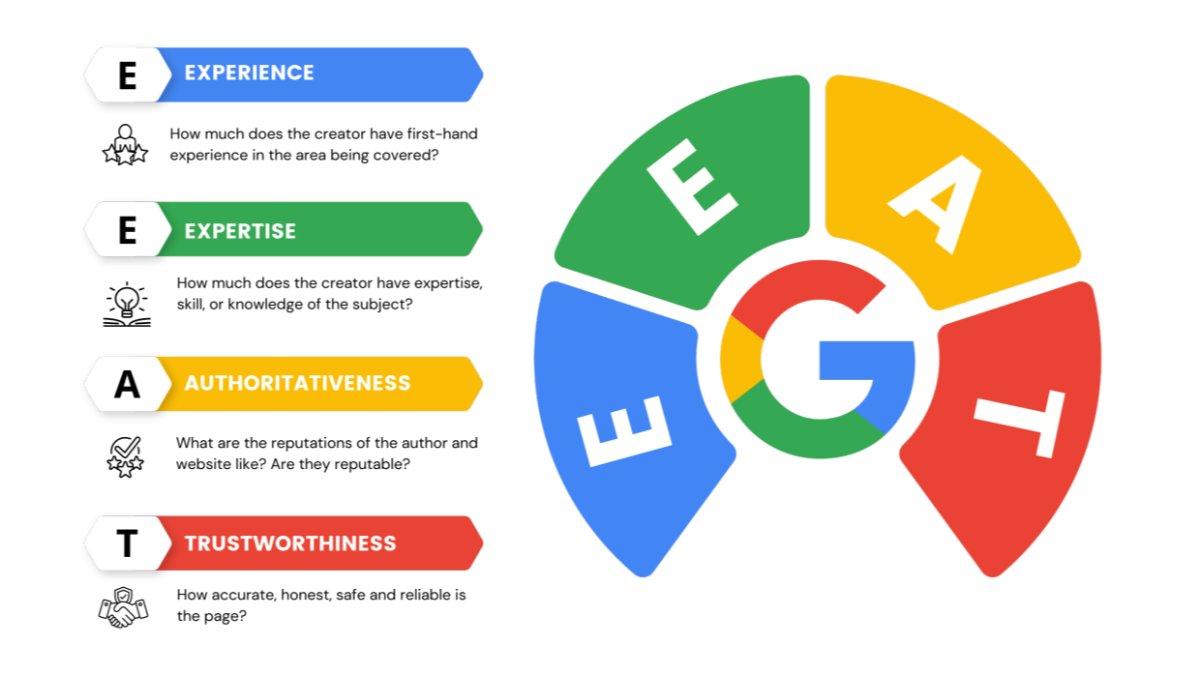
Google’s E-E-A-T framework (Experience, Expertise, Authoritativeness, Trustworthiness) is not a metric you can measure directly — but it profoundly influences how Google evaluates the quality of your affiliate content. This is especially true in YMYL (Your Money or Your Life) adjacent niches like finance, health, or technology products, where bad advice can cause real harm.
Importantly, data shows that only 25.1% of affiliate marketers were negatively impacted by Google algorithm updates in 2024 — and the affected sites consistently lacked E-E-A-T signals. Building these signals is your insurance policy.
How to build E-E-A-T for your affiliate site:
Experience:
- Write from first-hand use of the products you review. “I’ve been using this tool for 6 months” carries far more weight than generic feature descriptions.
- Include original photos, screenshots, or video of you using the product.
- Share real results: “After switching to this hosting provider, my page speed improved by 40%.”
Expertise:
- Display author bios with credentials, experience, and links to social profiles or other publications.
- Cite credible third-party sources (industry studies, Wikipedia, official documentation) throughout your content.
- Use accurate technical terminology appropriate to your niche.
Authoritativeness:
- Build your topic cluster (as discussed in Step 3) to establish domain-wide authority.
- Earn coverage and mentions from recognized sources in your industry.
Trustworthiness:
- Maintain a clear, prominent affiliate disclosure on every monetized page.
- Include an “About” page explaining who you are and why you’re qualified.
- Have a clear privacy policy and contact information.
- Keep your content updated — outdated reviews and pricing information are major trust killers.
Step 8: track, measure, and iterate
Knowing how to do SEO for affiliate marketing is one thing — knowing how to improve over time is what separates successful affiliate marketers from those who plateau. Measurement is the engine of growth.
Essential metrics to track:
| Metric | Tool | What It Tells You |
|---|---|---|
| Organic traffic | Google Search Console, GA4 | Which pages attract search visitors |
| Keyword rankings | Ahrefs, SEMrush | Where you rank and how you’re trending |
| Click-through rate (CTR) | Google Search Console | Are your titles/meta descriptions compelling? |
| Conversion rate | Affiliate dashboard + GA4 events | What % of visitors click affiliate links |
| Bounce rate / Engagement | GA4 | Are visitors finding what they expect? |
| Backlink growth | Ahrefs | Is your authority increasing? |
Review cadence: Do a content audit every 6 months. Update statistics, refresh product recommendations, re-optimize underperforming pages for current intent, and check for broken affiliate links. An affiliate page that was great 18 months ago may be losing rankings simply because the content is stale.

Common mistakes to avoid in affiliate SEO
Learning how to do SEO for affiliate marketing also means knowing what not to do. These mistakes have derailed many promising affiliate sites:
- Targeting only high-volume, high-competition keywords: Beginners consistently try to rank for “best laptops” instead of “best laptops for architecture students under $1500.” Go specific.
- Thin content with no original insight: Copying specs from Amazon and calling it a review doesn’t build trust or rankings. Add your analysis, comparisons, and experience.
- Ignoring user experience: Excessive ads, pop-ups, and difficult navigation hurt both rankings and conversions.
- Not disclosing affiliate relationships: This violates FTC guidelines and Google’s Webmaster Guidelines — and it erodes reader trust.
- Set-and-forget mentality: Affiliate SEO is not a one-time effort. Rankings decay without maintenance.
Frequently asked questions
How long does it take for affiliate SEO to work?
Typically 3–12 months to see significant organic traffic, depending on your niche competitiveness, domain age, content quality, and link-building efforts. New domains take longer; established domains with topical authority rank faster.
Can I do affiliate SEO without a blog?
A blog (or content-focused website) is the most common and effective vehicle for affiliate SEO. While YouTube SEO for affiliates is also viable, written content remains the dominant format for organic search traffic.
How many affiliate links should I include per page?
There’s no hard rule, but a natural ratio — 2 to 5 relevant affiliate links per 1,500-word article — is generally safe. Prioritize relevance and context over quantity.
Do I need to nofollow all affiliate links?
Yes. Google requires affiliate links (which are paid placements in the broad sense) to carry rel="nofollow" and/or rel="sponsored" attributes. Failing to do so can result in a manual penalty.
What’s the best niche for affiliate SEO?
The “best” niche is one where you have genuine knowledge or interest, the products have decent commission rates, and there’s sufficient search volume to justify your effort. SaaS, finance, health, and technology consistently perform well, but so do micro-niches in hobbies, home improvement, and outdoor gear.
>>> Related Guide
- Best finance affiliate programs for publishers 2026
- How to start High Ticket Affiliate Marketing for everyone in 2026
